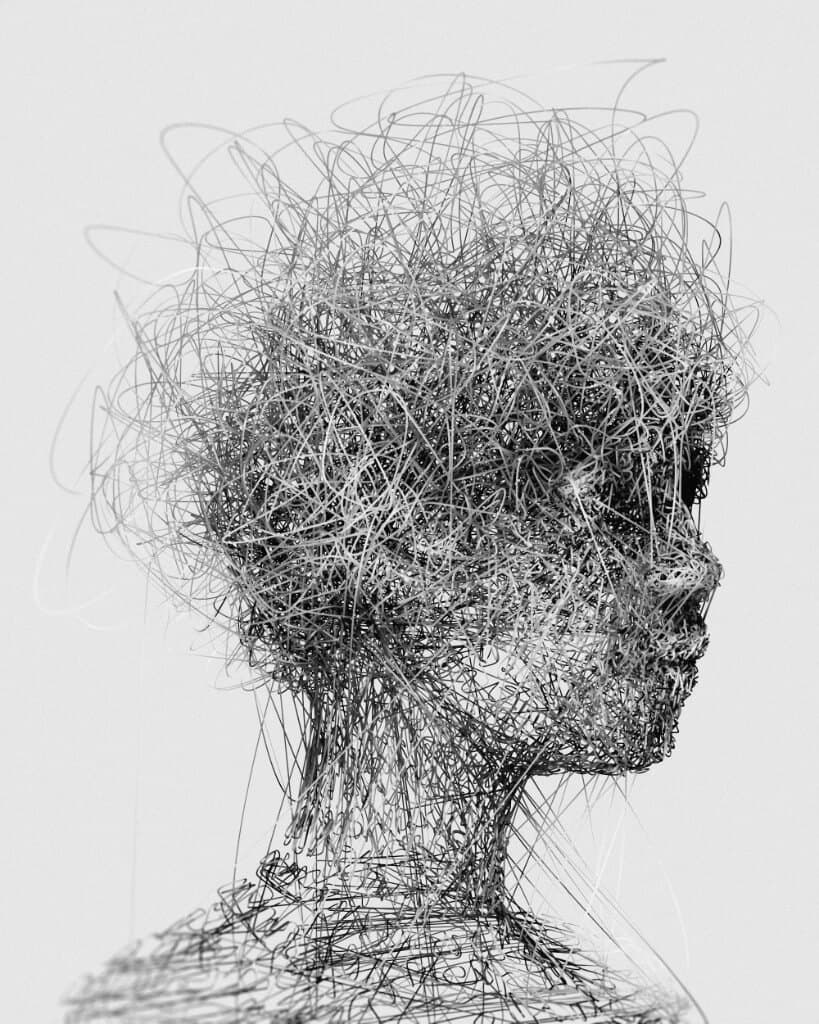
The Things You Recognise Without Learning Them
There are images that land before you can explain why. The flood that ends a world. The descent into the underworld and the difficult return. The wise old stranger who shows up at the turning point with exactly the thing you needed. You meet these in dreams you can't account for, in stories told by people who never met each other, in symbols that feel old the first time you see them.
Carl Jung spent his life on a single stubborn question about this. Why do the same shapes keep surfacing in minds that had no way of sharing them? His answer was the most ambitious idea in all of his psychology, and also the most misunderstood. He called it the collective unconscious.
Two Layers of the Unconscious
Jung's first move was to split the unconscious in two.
There's the part most people mean when they say "the unconscious" — your own buried material. Forgotten memories, suppressed feelings, the things you've pushed out of view because they were painful or inconvenient. Jung called this the personal unconscious, and on this point he and Freud broadly agreed. It's yours. It was built out of your particular life.
Then Jung argued for something underneath it. A deeper layer that wasn't built out of anyone's biography because it was there before the biography started.
A more or less superficial layer of the unconscious is undoubtedly personal. I call it the 'personal unconscious'. But this personal layer rests upon a deeper layer, which does not derive from personal experience and is not a personal acquisition but is inborn. This deeper layer I call the 'collective unconscious'.
Carl Jung, The Archetypes and the Collective Unconscious (1934)
This is exactly where Jung and Freud parted ways. For Freud, the unconscious was essentially personal — a basement filled with one person's repressions. Jung proposed a floor beneath the basement, identical in everyone, inherited rather than acquired. It was one of the deepest fault lines in their famous break, and Jung kept developing it for the rest of his career.
Where the Idea Came From
Jung didn't arrive at this from an armchair. He came to it from two directions at once.
The first was the consulting room. Working with patients — many of them at the Burghölzli psychiatric clinic in Zurich — he kept encountering dreams, fantasies and delusions populated by motifs the person seemingly had no way of knowing. The same images turned up in people of wildly different backgrounds, and they matched material from mythology and religion those people had never studied.
The second was the library. Jung read voraciously across mythology, comparative religion, alchemy and folklore, and he was struck by how often the same story-shapes and symbols appeared in cultures with no contact: creation and flood myths, the dying-and-rising figure, the hero's journey, the great mother, the trickster. He didn't think this was borrowing. He thought it pointed to a shared substrate the myths were all drawing from. The term itself first appears in his work around 1916, and he gave it its fullest treatment in the 1934 essays later collected as The Archetypes and the Collective Unconscious.
His most famous single piece of evidence is also his most contested. A man at the clinic, around 1906, described a vision of the sun with a hanging tube or phallus, and said the movement of that tube was the origin of the wind. Years later Jung came across a passage in an ancient Greco-Roman magical text, the Mithras Liturgy, describing almost the same thing — a tube hanging from the sun, the source of the wind. The patient, Jung argued, could not possibly have read it. Here was the collective unconscious caught in the act, producing an ancient image in a modern mind.
It's a striking story, and it's worth knowing that scholars have pushed back hard on it. The central objection is that Jung never really ruled out cryptomnesia — the possibility that the man had encountered the material somewhere and forgotten the source. The case can't carry the weight Jung put on it. That doesn't sink the broader idea, but it's a fair warning about how much any single anecdote can prove here.
The Misunderstanding Worth Clearing Up
This is the part most popular accounts get wrong, so it's worth being precise.
The collective unconscious is not a stockpile of inherited memories. Jung was not claiming you carry your ancestors' actual experiences, or specific images, encoded somewhere in your head. What's inherited, in his account, is not content but form — a set of predispositions to organise experience in certain recurring ways. He called these structuring patterns archetypes.
His own analogy was the crystal. Jung compared an archetype to the axial system of a crystal: the invisible structure that determines how the crystal will form, even though it has no material existence of its own and only becomes visible once the actual crystal grows. The archetype is the empty pattern. The myth, the dream, the symbol you actually experience is the crystal that forms around it, shaped by your own culture and life.
That distinction does a lot of work. It's why the same archetype — say, the mother — can show up as a nurturing goddess in one culture and a devouring witch in another. The underlying form is shared. The particular face it wears is yours.
What Lives Down There
If archetypes are the structuring patterns, several of them turn up again and again in Jung's work, and each tends to organise a recognisable kind of experience.
The shadow — everything the conscious self has disowned. The anima or animus — the contrasexual figure that so often gets projected onto the people we fall for. The wise old man and the great mother. The trickster who upends the order. And, at the center, what Jung called the Self: the archetype of wholeness, the totality the whole long process of individuation moves toward.
None of these is a character you invented. That's the felt signature of the collective unconscious — this material arrives feeling discovered rather than made up, often carrying more weight and authority than anything the conscious ego produces on its own.
How You Actually Meet It
You don't reach the collective unconscious by trying to think your way down to it. It tends to show itself sideways, in the places where the conscious mind loosens its grip.
In dreams, especially the rare ones that feel less like processing your day and more like being shown something — Jung called these "big" dreams, and they often carry imagery that seems too large for your own small history. In the jolt of recognition when a myth or an old story lands as though it were about you personally. In art and music that move you for reasons you can't quite articulate. In the strange clustering of meaningful coincidence Jung called synchronicity. And, most deliberately, in active imagination, his practice for engaging the figures of the psyche directly while awake.
The common thread is that you're not generating the material. You're receiving it, and then paying close enough attention to notice what showed up.
The Honest Caveat
It would be dishonest to present the collective unconscious as settled science. It isn't.
Mainstream psychology does not accept the literal claim that specific archetypal structures are biologically inherited, and the evidence Jung leaned on — cross-cultural parallels, suggestive clinical cases — is interpretive rather than experimental. The Solar Phallus Man is the cautionary tale here: a vivid story that turned out to rest on shakier foundations than its retelling suggested. Recurring symbols across cultures can also be explained, at least in part, by shared human biology, common life circumstances, and ideas travelling between peoples more than Jung assumed.
What survives the skepticism is more modest and, honestly, more useful. There clearly are images and story-shapes that recur across human cultures and that reliably move people who have never been taught them. Whether that's because of an inherited psychic structure or because we're all built from the same equipment facing the same handful of unavoidable experiences — birth, love, loss, death — the pattern is real, and treating it as a lens is one of the most productive things you can do with your own inner life. You don't have to buy the full metaphysics to take the experience seriously.
Used well, the collective unconscious stops being a theory to defend and becomes a way of reading yourself: a reminder that the figures who show up in your dreams and the people you can't stop reacting to are often older and less personal than they feel, and that paying attention to them is how you start to know what's actually moving underneath.
Shadow Journal is built for exactly this kind of attention — turning your entries into Jungian reflection, helping you notice the recurring figures and symbols that surface in your own writing, and giving you somewhere to stay with them long enough to learn what they're pointing at.